Memoir Moments
The National’s
Once a year in the fall, the NCESA (National Class E-Scow Association) holds its championship regatta. The event is held on different lakes each year, rotating through various yacht clubs in its regions. I was 21 the first time the Nationals came to Crystal Lake in 1973.
1970 through 1976 were my “snowbird” years, where I summered at Crystal Lake and wintered in Albuquerque pursuing a Bachelor of Fine Arts at the University of New Mexico. I like to say I painted my way to a BFA because during those years, I ran a house-painting business at Crystal Lake to help pay for my education.
1973 was the first year I monetized my artistic abilities. The Crystal Lake Yacht Club commissioned me to design and create the event trophies. I also designed and sold a T-shirt for Regatta. The T-shirt cost included free beer until the kegs ran out. Those who are familiar with sailors won’t be surprised to hear that I sold out very quickly.
The weekend the regatta came to town was windy, and on Sunday it blew twenty-five knots, with gusts up to thirty-five. Skippers and crew gathered on the CLYC beach, waiting to hear whether the races would be canceled because of the high winds.
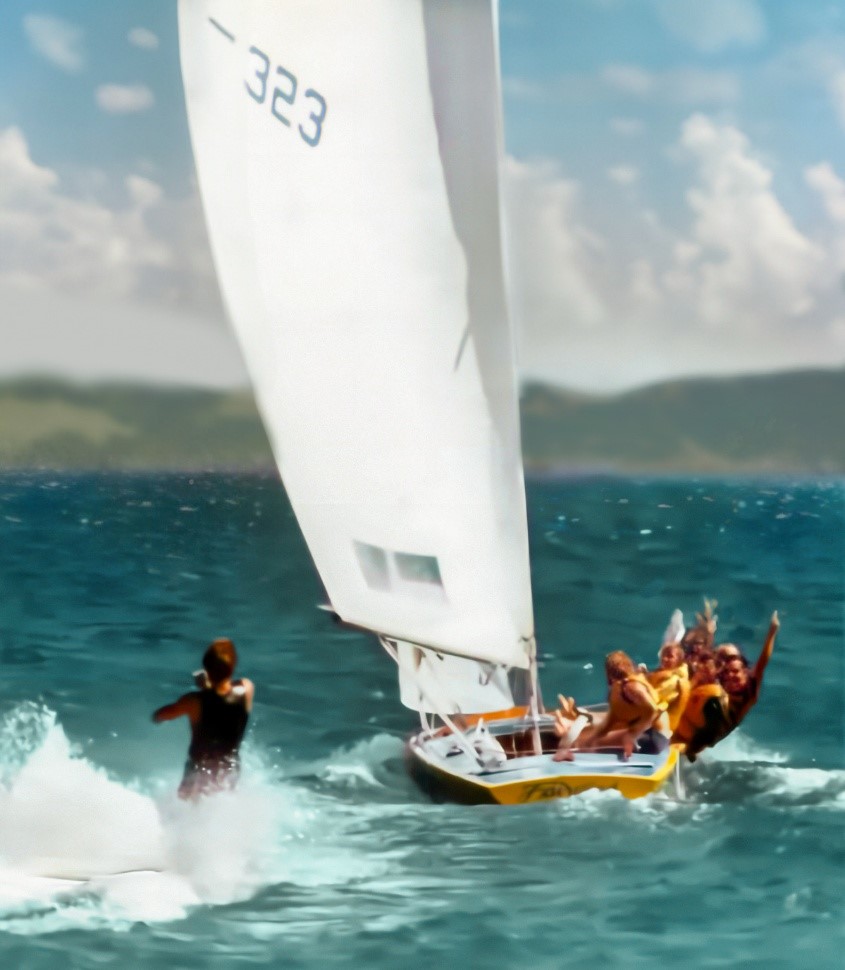
I was thinking it was the perfect time to show what an E-scow can do in these conditions, and we knew how to handle them. I enlisted four beefy crew, borrowed my friend Harold McClure’s new E-scow, and put on a show for the Yacht Club. We even set a spinnaker and screamed downwind past the Yacht Club. For those unfamiliar with the E-scow, it is basically a 28-foot-long, 1,000-lb surfboard with a planing hull. Unlike a displacement hull, which pushes water aside, a planing hull generates lift through its shape, allowing it to skim the water’s surface or plane off while reaching downwind. Their mainsail and a jib are 323 square feet of sail. Their spinnakers add another 550 square feet of sail power. Setting a spinnaker is like kicking in the nitro on a race car, just a whole lot quieter. E-scows have been clocked at close to thirty-five miles an hour while reaching downwind with a spinnaker. I’m pretty sure we topped that speed when a gust hit us and made the rigging groan. I held my breath and the tiller, feeling the power we’d lassoed with our sails surging through me. I wondered if this wild wind would rip the mast from the deck. An observer from the beach said they saw our hull go airborne all the way back to the rudders as we rocketed downwind.
For years, it had been rumored that an E-scow could pull a slalom skier. What better day to find out, I’d thought. I asked my friend Mike Huck if he was game. “Hell yes,” he grinned, “I’ll meet you at the end of the yacht club dock, what time?”
When Mike came sauntering down the dock heading for the lake with a slalom ski on his shoulder, he caught everyone’s attention. You could almost hear the – What the, what the? -rising from the crowd. Our timing was perfect; Mike was ready to go when we came about at the end of the dock, and threw him a tow rope cleated to the transom. Loosely sheeted in, sails flapping, we slowly moved forward, taking the slack out of the tow rope, waiting for his signal to “Hit it!” He grinned and gave it. We furiously sheeted in, and he popped right out of the water. The crowd that had been milling around on the beach, waiting to hear if the races were going to be canceled, jumped to their feet in a roaring, standing ovation as we sailed away with Mike in tow, proving that yes, an E-scow can pull a slalom skier.

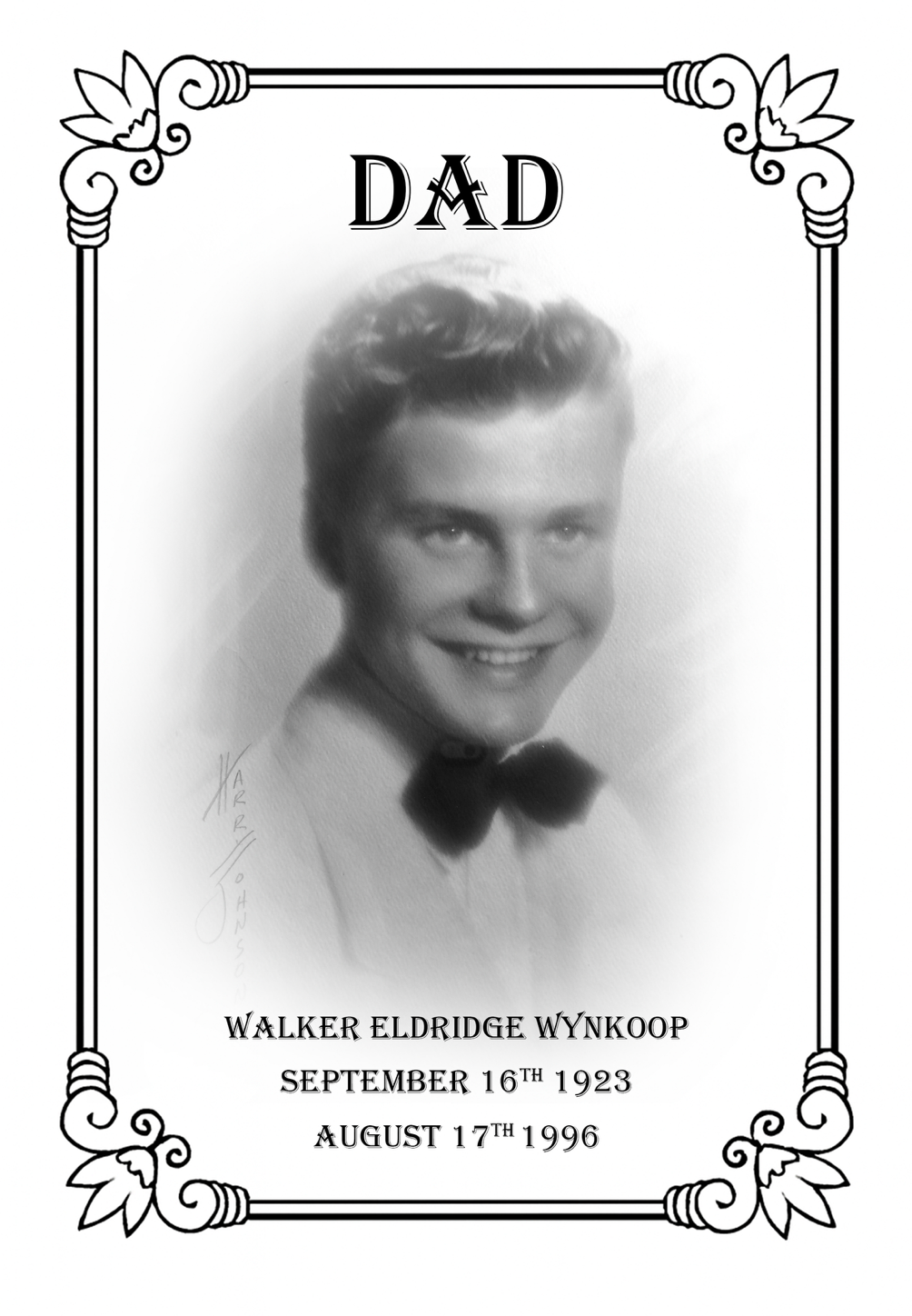
Dad was passionate about flying, chess, and sailing, but Crystal Lake was where his heart lived.
His family has owned 120 acres of woodlands and dunes between Lake Michigan and Crystal Lake since 1906.
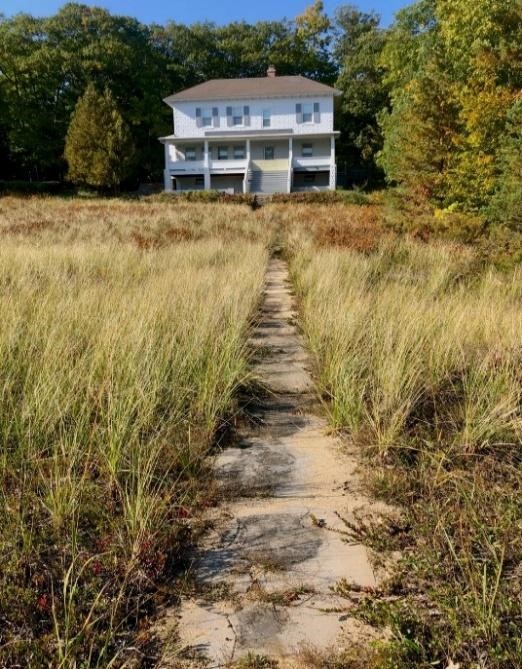
At the heart of the property was The Big House, the three-story summer home his family built around 1908, along with a barn, caretaker’s house, and an ice house on Crystal Lake. Each spring, slabs of lake ice were harvested and stored in the ice house, providing turn-of-the-century refrigeration.
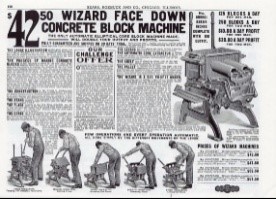
The buildings themselves were made from cinder blocks formed on the property from cement and local materials using a Sears and Roebuck Wizard concrete-block machine.
Finished eleven years before the dirt two-track running down the west side of the family property became M-22, The Big House still stands today.
In 2015, M-22 was rated #1 Best Scenic Autumn Drive award by USA Today’s Readers’ Choice poll.
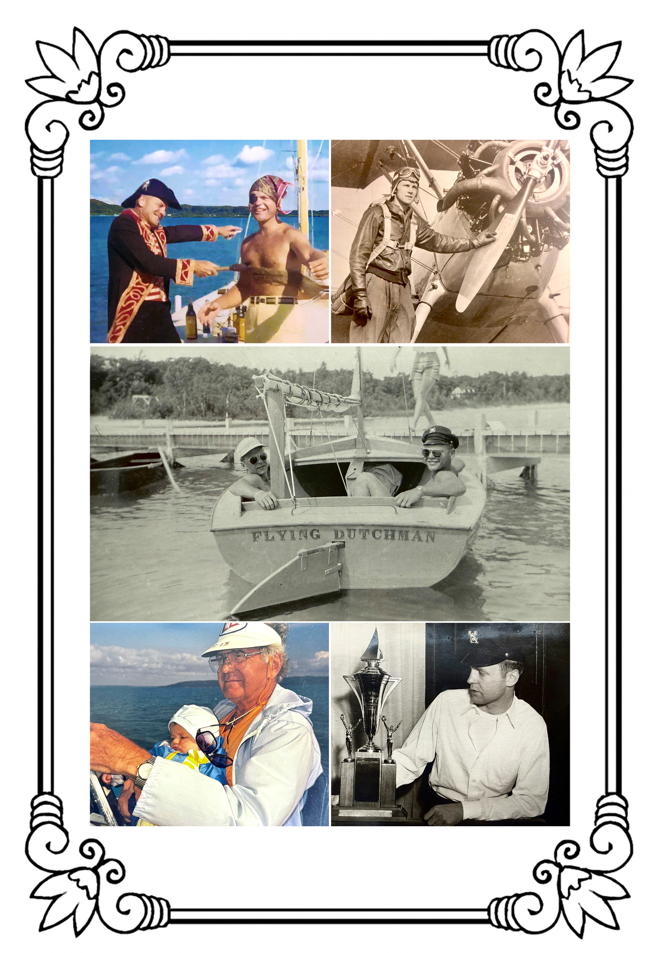
Through his teen years, Dad spent every summer here. The Big House sat within easy walking distance of the Crystal Lake Yacht Club, where he first learned to sail. On Crystal Lake, he fell in love with racing sailboats—any size, anytime, anywhere—from dinghy racing on Illinois’s Skokie Lagoons to Star boat racing out of Chicago on Lake Michigan. But his true passion was Scow sailing on Crystal Lake, especially the fast, powerful E-Scows.
Except for his years serving in World War II, Dad never missed a summer at the Lake. As a working man living in the Chicago area, he drove up every weekend in the summer to sail the waters he loved. That meant twelve to fourteen hours on the road, round trip, every weekend.
The Lake was his little slice of heaven sandwiched between work weeks.
Dad crewed on the boat Rangoon in the Chicago-Mackinaw race. His knowledge of local conditions and his ability to read the sky played a big part in their second-place finish that year.
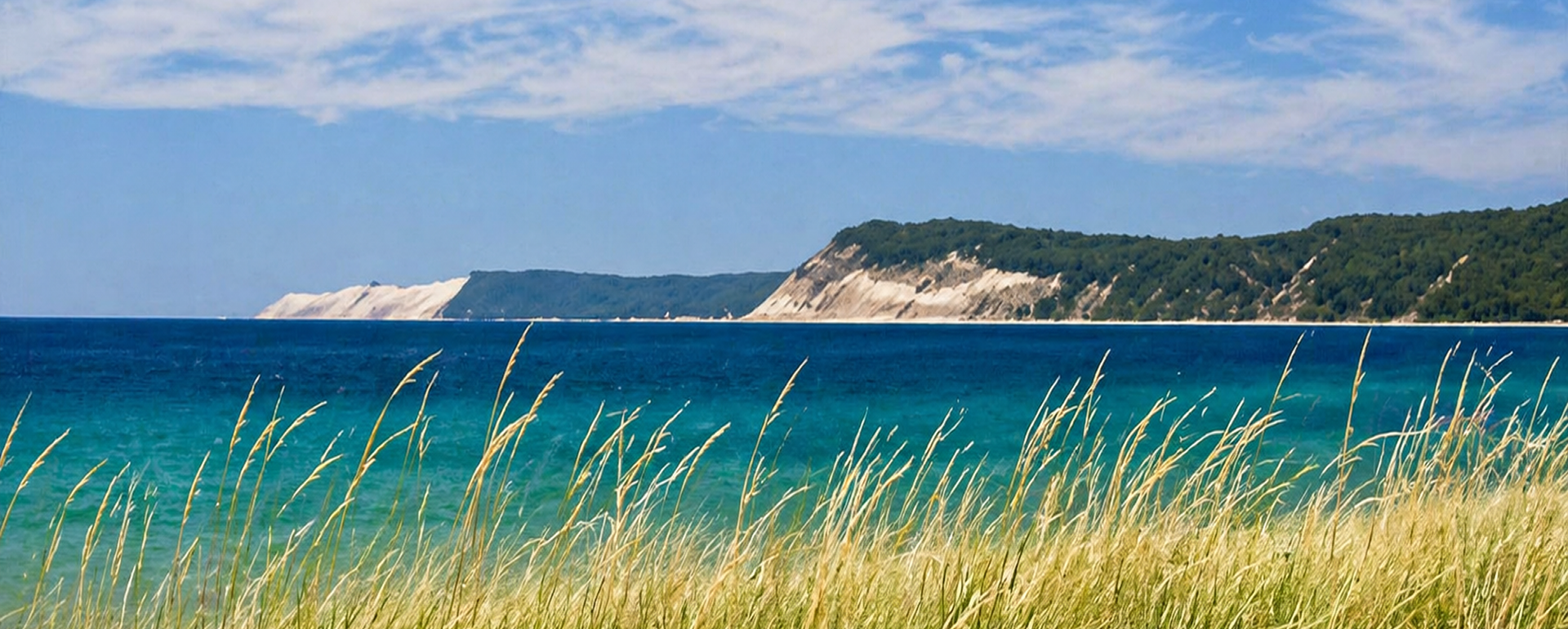
Much of the fleet was working its way north through the Manitou Passage when the already light westerly winds began to die off. It had been a muggy, hot summer day. Thanks to Dad’s ability to capture the lightest of winds, his “ghosting” skills, he kept the Rangoon moving toward the dunes and the promise of a shore breeze. He knew that on days like these, the heated land could generate a robust thermal offshore breeze, one that wouldn’t venture far offshore.
As the sun set, Rangoon’s crew could see a dark band of ruffled water growing toward them from the Sleeping Bear Dunes. Rangoon’s sails soon filled with the thermal winds, and she started moving right along while the rest of the fleet remained becalmed farther offshore.
The nautical charts showed they could hug the shore all the way to the Mackinaw Bridge, so they did, cruising along at a sprightly twelve knots all night.
At daybreak, they were closing in on the transom of the lead boat and perennial winner, and almost overtook her.
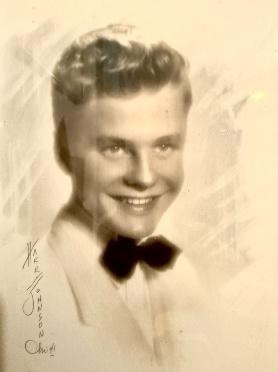
My Father’s love for sailing became mine. I raced with him on his E-Scow named Storm almost every weekend from the age of twelve until I was twenty-five.
Dad was brilliant. Hungover from his 60th birthday party, he took and passed the MENSA test.
However, I have heard it said that there can be a vast difference between being intelligent and being smart.
He was a poet out of place, a philosopher and a dreamer pressed into taking over his Father’s business when his dad died quite suddenly from lung cancer.
It was not a good fit, and both my Father and the label printing company his Father built suffered as a result.
Dad became a pilot in World War II. He loved flying almost as much as he loved sailing.
When he could afford a private plane, like a Piper Cub, he flew up to the Lake on weekends.
I will never forget seeing a rainbow for the first time while flying home to Chicago with him. Much to my surprise, it was a luminous circle below us. He just smiled when I excitedly pointed it out to him and said, “That’s what a rainbow looks like when the horizon doesn’t get in the way.”
I was forty-four years old when Dad died in the summer of 1996. He was 73.
He’d been following the E-Scow races in his motorboat, watching his granddaughter round the upwind mark in first place, when he suddenly became ill. He was taken to the local hospital, where he died.
I arrived shortly after his passing and was given time alone with him in a holding room. I sat beside him and sang Northern Winds & Crystal Waters, his favorite song of mine, one last time.
His Love filled the room.
I was born during a raging snowstorm on Saturday, January 5th, 1952, at 4:37 am. Due to the weather, many roads were closed, and Mom would not give birth to me at the hospital of choice or be attended by her OBGYN. Instead, I was born at Saint Francis Hospital in Evanston, Illinois, where some of the nurses were nuns.
Mom had a long and arduous labor bringing me into the world. Lots of screaming. She was shrieking from the pain of my imminent arrival when an exasperated Nunnly Nurse said, “Oh, be quiet! I’ll bet you didn’t make those kinds of noises when you were making that baby!” To which Mom replied, “HOW THE HELL WOULD YOU KNOW?” or so Dad told me.
That was Mom, a five-foot-four-inch, one hundred and twenty-pound redheaded spitfire. She was a clothes designer and fashionista. I learned much from her. She was an artist, a dancer, and a romancer. She had hoped to go to college to become an artist, but that dream fell apart when she became pregnant with my older brother, Walker.
After my parents divorced, Mom loved dancing all night in Chicago with her romantic partners.
She also loved drinking, a bit too much, and eventually found her way to rehab at Hazelton, and then AA.
At her wake, several of her romantic partners made a point of taking me aside to let me know how magical it was to be on a moonlight sail with Mom.
Yes I Am
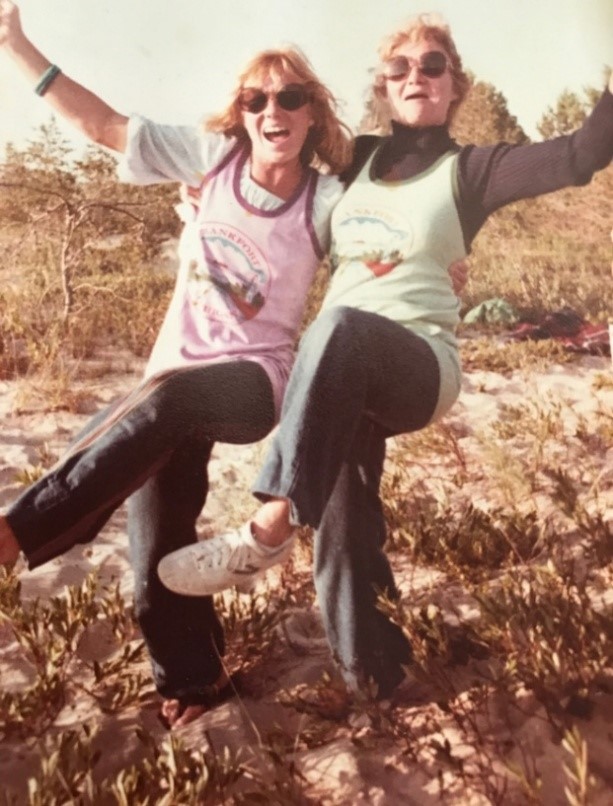
Party gurls, Mom, Lisbeth on the left, and her sister Margo on the right
I was 49 when she died in May of 2001, and Mom was 71. Earlier that Spring, she’d found out she had inoperable lung cancer. Not too much later, I got a call from my sister Kiki, letting me know that Mom was nearing the end and that if I wanted to see her one last time, I’d better book a flight. So I did, then called Mom to let her know I would be down to see her the next day. We talked about many things, including life after death. She made it very clear that she had it on good authority from Carl Sagan that there was nothing after death. End of subject, move on. For those of you who don’t know Carl Sagan, his PBS show, Cosmos: A Personal Voyage, promoted provocative yet user-friendly science in the 80’s and was viewed by over 500 million people across 60 countries.
I couldn’t help but wonder if Carl had changed his outlook since passing away five years earlier, based, of course, on his scientific observation.
I’m pretty sure – no – I’m sure I had smoked pot that night and ended our phone call with some new age- hippie-dippie shit like, “Don’t worry, Mom, everything is going to be alright.” To which she growled, “Huh, doesn’t feel like it to me.”
Those were her last words to me. By the time I got to her the next day, she was comatose and hadn’t moved or spoken since the night before. When I got to Mom’s room, her bed was tilted, so she sat somewhat upright in a reclining position, with her arms resting at her sides.
My inner ear kept hearing her ask me to lie down beside her. But the room was filled with the hustle and bustle of relatives coming and going, mourning and forlorning, all morning, and I did not feel comfortable about lying next to her in a crowd. After lunch, the room cleared, and I finally lay down next to her. She at once sat straight up, both arms raised toward the ceiling in a “Hallelujah!” gesture that said, “Well, it’s about god damn time!”
That was the last time she moved and her goodbye gesture to this world.
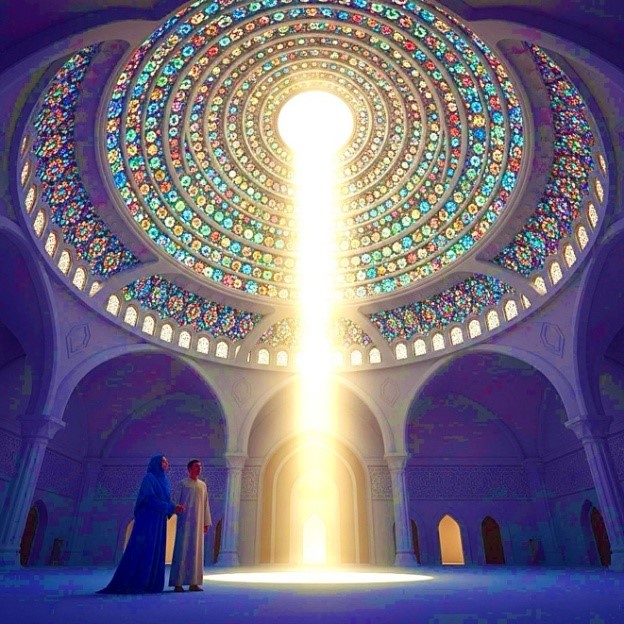
Maybe I dozed off lying next to her because I hadn’t slept much the night before and had an extra early flight to Florida. But it doesn’t explain the dream like altered reality I found myself in. A state every bit as real as the one where I was lying next to her in her hospice bed. In this other reality, we were standing in darkness under a vaulted, mosque-like dome, glittering with backlit jewels of many colors. At the apex was a circular opening letting in a shimmering shaft of light that sparkled all the way down to the floor. I looked at Ma and saw she was looking up at the light too. I smiled at her and said, “See, I told you there was something more.” Without hesitation, she quipped, “What, you trying to get rid of me?”
That was Mom, alright! I laughed, gave her a hug and a kiss, and said, “No, Mom, I’m not trying to get rid of you,” then pulled her close and whispered in her ear, “Say hello to Carl Sagan for me, would ya?”
Sneaking Up On Me
Shhh… listen
Do you hear it?
I can hear it
Creeping through the trees
and whispering on the breeze
there’s a poem sneaking
up on me
I can even feel it
’cause there’s
crazy in my veins
and magic in my brain
I got dancing in my feet
and love for all I meet
there’s laughter in my eyes
and even a little frisky in my thighs
Ohhhhh…
I love it when a poem’s
sneaking up on me
And
I know
I know
I’ve heard
what’s been said
that I’m bonkers
in the head
and I’ve heard
their overrated
bloviated, opinionated
septic point of view
that I’m just one poem away
from an everlasting stay
down at what they call
crazy hall
Lord knows
I try to behave…
Well, I try to behave…
But ya know what?
I’m just not built that way
’cause when the next poem
tries to sneak on by
I will snatch it
from the sky
I will wrestle
it to the ground
and I will
write it down
then I’ll send it off to you
just in case you’re feeling blue
Ohhhhh…
I love it when a
poem’s sneaking
up on me
The Wild
On autumn
days like these
when so many trees
are becoming drowsy
and are no longer filled with
the hearty laughter of summer
it is easier to hear
so much easier
to hear
The Wild running free
it’s building bridges
from my heart
to the clouds
the WIND
and the trees
while stirring
my nimbus memories
of talking to the clouds
about the coming rain
That’s when
the Wild invites
my molecules
to come join
the mist again
once my words
about all that is
are said
& done
On days
like these
my molecules
gladly accept
the Wild’s invitation
promising that once
they arrive
we will paint
the clouds above
with all the beauty
we have seen
from below
On autumn days
like these
Clearing Sky’s
I love science
because through
its understanding
and application
of the exacting laws
governing our physical world
science has manifested
many of the miracles
of our modern
age…
like sending
this text to you
And science
makes it clear
that just because
I couldn’t see
the stars last night
they were still there
never went anywhere
they were just hiding
behind clouds
in the air
But neither science
nor my heart can explain
what I felt when the stars
started smiling down at me
through the openings
in a clearing night sky
and began acting
like frolicking children
coming home from afar
bubbling over
with stories
to share
from all their
adventures
out there
Turning Point – Memoir Moment
On those rare
windless
moonless
crystal clear
nights
when lakes
reflect the
heavens
above
without
so much
as a ripple
in their skin
You can see
their dreams
and they can
see yours
This last stanza from my poem Lakes and Trees poetically describes the most significant turning point in my life, and it was all about dreams. Not the nocturnal kind. The living kind, as in: if I could articulate my dream life, what would it look like?
I didn’t know.
It was three a.m. I sat in the family cottage looking out at Crystal Lake, reflecting the heavens above without so much as a ripple in her skin. My son and wife were asleep upstairs. They didn’t know I’d lost my job as Western Regional Sales Manager, and a lot of big changes were coming our way. The part of me responsible for providing for my family and paying the mortgage felt desperate, trapped, and without options. But the part of me looking to live a life my soul would say HELL YES to sensed freedom, like the jailer had left my cell door open.
Usually, the still, small voice within guides me through significant, life-changing moments like this. But that night at the cottage, nothing. No hints or nudges in the right direction. It felt like the voice within was holding its breath in a stillness so deep that not even molecules moved while the Universe waited for my answer to the question:
What’s next? What do you want?
I was forty-four, and sitting there in the darkness, I began taking inventory of the dreams I’d already followed.
First had been my mother’s unrequited dream of attending college and becoming an artist. I’d received a Bachelor of Fine Arts degree from the University of New Mexico. My ceramic creations had been featured in shows and sold through the renowned Mariposa Gallery in Albuquerque’s Old Town. I’d had an opening there, and the Albuquerque Journal wrote about my work, recognizing my talent. I taught art part-time at the New Mexico Institute of Mining & Technology and was looking into getting a graduate degree so I could teach art full time at the university level.
To support that dream, I took a $5-an-hour job that turned into a twenty-year career in sales and installation of flexible membrane liners in the little-known geosynthetics industry.
Truth be told, after six years of creating objets d’art, the well had dried up. My passion for making the next piece of art was nowhere to be found.
Oddly enough, my $5-an-hour job installing membrane lining systems kept opening up new opportunities in corporate America—a place where my Father had struggled to be successful.
Yet even as I followed that path, something inside me kept asking questions the career couldn’t answer.
I remember pulling over to make a sales call at a roadside phone booth in California. I couldn’t help but notice the vibrant green blades of spring grass growing around its base. Unexpectedly, I began weeping as my heart asked the grass, “How? How do you do it? How can you so effortlessly be in place in the Universe while I’m lost, out of place, and clueless about why I’m here?”
Being clueless might not have been so bad if something deep inside me hadn’t kept insisting I was here for a reason.
And now, twenty years later, that path had come to an abrupt end, forcing the answer to the question: Would I live close enough to Crystal Lake to commute every weekend as Dad did?
No.
There I was at three in the morning, sitting beside Crystal Lake with the heavens reflected in her still waters, looking back at the dreams I’d already followed and realizing I couldn’t answer the simplest question of all:
What did I want?
I had not given it much thought while chasing the next opportunity.
At that moment, the only thing I knew to be true was that I wanted to live in Northwest Michigan. And that was the beginning of the treasure hunt for the life my soul would say HELL YES to.
I trusted this truth, honored my longing, cashed in my 401(k), penalties and all (ouch), and moved our family to Northwest Michigan to be near Crystal Lake.
In my journey toward finding and living my purpose, I’d entered a time of initiation. Parts of who I thought I was were dying while a different kind of me struggled to be born. It was an excruciating mix of freedom, uncertainty, and fear, with no guarantee of a storybook ending, especially financially. I went from a salaried position with benefits to trying to become a carpenter working outdoors for $5.00 an hour during a winter when Lake Michigan froze over.

I’m starting to suspect $ 5.00-an-hour jobs = big changes in my life.
To survive our initial years up north, one of the first things I had to let go of was my inherited share of the family property on Crystal Lake. I sold it to my brother. Later, I came to appreciate how lucky I was to own none of it when the family divided the 60 acres of woods between Crystal Lake and Lake Michigan that we inherited from our grandmother. Sadly, I watched family members spend inordinate amounts of time and money attacking each other in court over the division.
Watching the family feud from the sidelines made it clear that my connection to Crystal Lake had nothing to do with ownership and more to do with relationship.
The curriculum of my transformation included experiential trainings like Tony Robbins’ Unleash the Power Within weekend, where, in an exercise designed to confront my fears and prove to myself that I can move past my limiting beliefs, I walked barefoot across hot coals while chanting, “Cool moss, cool moss, cool moss.”
Over the years, I’ve walked the hot coals three times.
At a Passion workshop, the staff asked us to pick up and carry a large stone representing our life’s burdens. The leader made it clear that when we got to the point where we thought we couldn’t carry our burdens any longer… we should carry them a little longer. I picked up a large stone and headed outside. It was January, and the site was next to a Lake, presumably frozen. I didn’t care. All I knew was the Lake was calling to me, “Come.” So I did. I walked until I was about a mile offshore. Arms aching, I was about to let the rock go when I remembered,”Carry them a bit longer.” So I did.
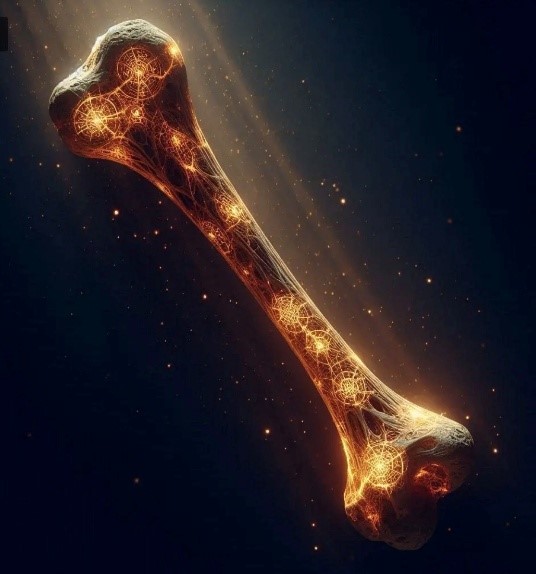
That’s when, eyes closed, I had a vision of a long, age-stained, femur-like bone floating in the murky darkness of my imagination. Gradually, the femur began to turn, and ancient glyphs appeared on its surface. At first, the glyphs were dark, but as the bone continued to turn, their color steadily shifted from black to gold. Then the glyphs began to glow, emitting a golden light from within the bone. Soon, I was looking at a bleached white bone floating in a clear blue sky, its glowing glyphs filling my vision with the warmth of a summer day.
That’s when I dropped my stone.
This vision felt like a clue, a significant piece of the puzzle as to why I am on earth.
At the Mankind Project’s New Warrior Training Adventure, a weekend initiation ritual for men, I came face to face with my deep-seated fear of men. In an accountability exercise, one of the staff members challenged me to examine something I’d done. I was open and eager to do so because my life wasn’t working, and I was desperate to find out why.
In this exercise, I stood in the front of the room, all eyes on me. My fellow initiates were sitting on the floor in front of me. Standing in a semicircle around the initiates were twenty-three imposing, stern-faced staff members, dressed in black with faces smeared black.
My acceptance letter for the weekend clearly stated when and where to show up. I was asked, “Why had I shown up three hours early?” Good question. I didn’t have an answer.
One of the leaders stepped forward and asked me, “Do you think you did that because you don’t feel safe around men? Especially, men you don’t know, and maybe you wanted to check things and get the best campsite?” My soul was relieved to hear my truth, “Yes, yes, that’s it,” I stammered and began to weep. If given half a chance, I might have thought, “This is no place to cry and show weakness surrounded by so many scary-looking men I don’t know.” But before I could even think about my vulnerability, in unison the staff said,
“Your tears are welcome here.”